Why Is My Bike Exhaust Smoking? Causes, Smoke Colours & Solutions
Noticing smoke coming from your bike's exhaust can be worrying. Sometimes it is harmless condensation, but continuous white, blue or black smoke may indicate an engine, fuel or combustion-related problem. Ignoring unusual exhaust smoke can lead to poor mileage, reduced performance, increased oil consumption and expensive engine repairs.
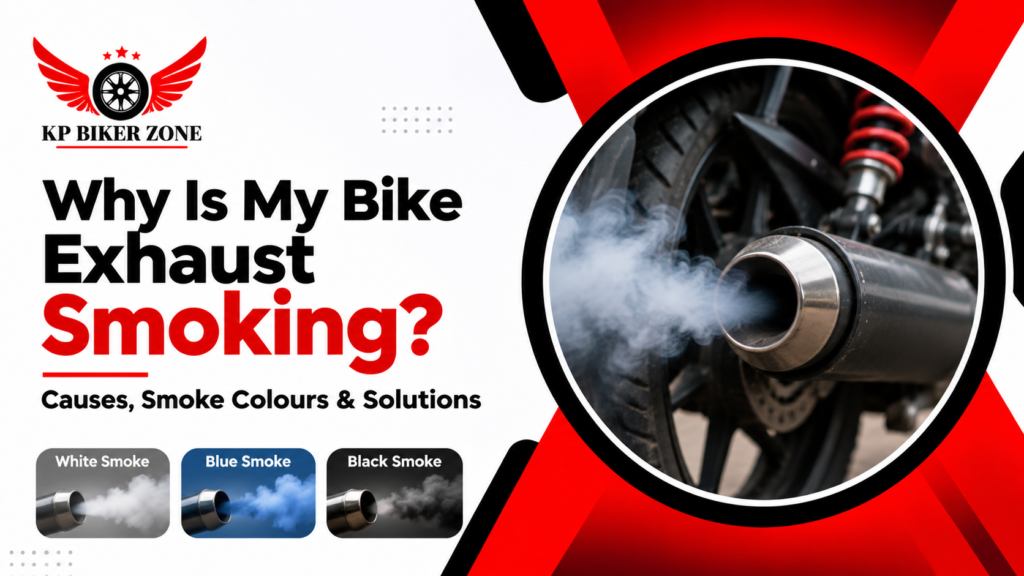
The colour of the smoke, the time when it appears and the way your bike performs can provide useful clues about the problem. For example, blue smoke may indicate engine oil burning, while black smoke is commonly associated with excess fuel. This guide explains the possible causes, warning signs, inspection methods and solutions for bike exhaust smoking.
What Does Your Bike Exhaust Smoke Colour Mean?
The colour of exhaust smoke provides an initial clue about what may be happening inside the engine. It is not a final diagnosis because different mechanical problems can sometimes produce similar symptoms. A proper inspection is necessary before replacing any parts.
*Most motorcycles are air-cooled. Coolant-related causes apply only to liquid-cooled models.
1. White Smoke From Bike Exhaust
White smoke or vapour may appear when you start your bike, especially in cold or humid weather. If it disappears after the engine warms up, it is often normal condensation. Water vapour forms inside the exhaust system while the motorcycle is parked and evaporates as the exhaust becomes hot.
Possible Causes of White Smoke
- Normal condensation: Moisture collects inside the exhaust system when the bike is parked. It usually produces light vapour that disappears after a short time.
- Coolant entering the combustion chamber: On liquid-cooled motorcycles, a damaged head gasket or another sealing problem may allow coolant to enter the engine cylinder.
- Internal engine damage: Persistent dense white smoke on a liquid-cooled bike may indicate an internal sealing or engine problem that needs inspection.
- Cold engine operation: Vapour may be more noticeable during cold starts and usually reduces as the engine reaches operating temperature.
Warning Signs to Check
- White smoke continues even after the engine becomes warm.
- Coolant level keeps decreasing on a liquid-cooled motorcycle.
- The engine temperature rises abnormally.
- The bike starts losing power or running unevenly.
What to check: Observe whether the vapour disappears after warming up. On liquid-cooled bikes, check the coolant level when the engine is completely cool and look for signs of overheating. Never open a hot radiator cap.
2. Blue Smoke From Bike Exhaust
Blue or bluish-grey smoke is commonly associated with engine oil entering the combustion chamber and burning along with the fuel-air mixture. This is one of the important warning signs of possible internal engine wear or an oil-control problem.
When engine oil enters the combustion chamber, it burns along with the fuel. This can increase oil consumption, leave deposits on the spark plug and affect engine performance over time.
Common Causes of Blue Smoke
- Worn piston rings: Piston rings help seal the combustion chamber and control oil movement along the cylinder wall. Worn or damaged rings may allow engine oil to enter the combustion chamber.
- Worn cylinder bore: Excessive cylinder wear or damage can affect the sealing between the piston rings and cylinder wall.
- Damaged valve stem seals: Worn valve seals may allow oil to pass through the valve area into the combustion chamber.
- Incorrect engine oil level: Overfilling the engine with oil can sometimes contribute to oil entering the intake or combustion system, depending on the engine design.
- Crankcase breather issue: A blocked or malfunctioning breather system may cause oil vapour or oil mist to enter the air intake.
When Does Blue Smoke Appear?
| When Smoke Appears | Possible Cause |
|---|---|
| Immediately after starting | Possible valve stem seal leakage |
| During acceleration | Possible piston ring or cylinder wear |
| After prolonged idling | Possible oil passing through valve seals or other oil-control issues |
| Continuous blue smoke | Possible internal oil burning problem |
These are diagnostic clues, not definite conclusions. A mechanic may need to perform compression, leak-down or other engine tests to identify the actual cause.
What to check: Monitor engine oil level regularly, observe when the smoke appears and get the engine inspected if blue smoke continues. Avoid riding with insufficient engine oil.
3. Black Smoke From Bike Exhaust
Black smoke usually indicates that the engine is burning more fuel than required, commonly known as a rich fuel mixture. When there is too much fuel compared with the available air, combustion may become incomplete. This can cause fuel wastage, carbon deposits, poor mileage and reduced engine performance.
Common Causes of Black Smoke
- Dirty air filter: A heavily clogged air filter can restrict airflow and disturb the air-fuel mixture.
- Carburettor problem: Incorrect tuning, a faulty choke or a problem with the float system may supply excess fuel.
- Fuel injector issue: A leaking or malfunctioning injector may deliver more fuel than required.
- Sensor-related fault: On fuel-injected bikes, a faulty sensor may provide incorrect information to the engine control unit and affect fuel delivery.
- Incorrect tuning: Improper fuel-system settings can result in incomplete combustion.
- Choke not returning properly: On carburettor-equipped bikes, a choke that remains engaged after starting can cause an excessively rich mixture.
Other Symptoms Along With Black Smoke
- Sudden reduction in fuel mileage.
- Strong smell of unburnt petrol near the exhaust.
- Rough idling or uneven engine running.
- Black deposits on the spark plug.
- Difficulty starting or poor throttle response.
What to check: Inspect the air filter and fuel system. If the bike is fuel-injected, diagnostic checks may be needed to identify sensor or injector faults. Do not change fuel-system settings without checking the actual cause.
7 Common Reasons Your Bike May Produce Smoke
| Possible Cause | Common Sign | Recommended Check |
|---|---|---|
| Worn piston rings | Blue smoke and oil consumption | Compression or leak-down inspection |
| Worn valve seals | Blue smoke after starting or idling | Valve seal inspection |
| Dirty air filter | Black smoke and poor pickup | Air filter cleaning or replacement |
| Carburettor fault | Black smoke and high fuel consumption | Carburettor inspection and tuning |
| Fuel injector issue | Black smoke and uneven running | Injector inspection and testing |
| Coolant leakage* | Persistent white smoke and overheating | Cooling system and head gasket check |
| Excess engine oil | Oil-related smoke or oil in intake | Check oil level and specification |
*Applicable to liquid-cooled motorcycles. Symptoms can overlap, so inspection is necessary before replacing parts.
Does Smoke Appear Only During Starting or While Riding?
The timing of exhaust smoke can help narrow down the possible issue. Observe whether the smoke appears only when the bike is started, during acceleration or continuously while riding.
| Smoke Pattern | Possible Explanation |
|---|---|
| Light vapour during cold start | Often normal condensation |
| Blue smoke after starting | Possible valve seal or oil-control issue |
| Blue smoke during acceleration | Possible piston ring or cylinder wear |
| Black smoke during acceleration | Possible rich fuel mixture or fuel-system issue |
| Continuous dense smoke | Requires proper engine and fuel-system inspection |
These patterns are useful for describing the problem to a mechanic, but they cannot confirm a particular faulty component without testing.
How to Identify the Problem Before Visiting a Mechanic
Before arranging a repair, observe a few basic signs. Sharing these details can help the mechanic understand the problem more accurately and decide which components need inspection.
Basic Checks You Can Observe
- Smoke colour: Note whether it is white, blue, bluish-grey or black.
- Starting condition: Check whether smoke appears only during a cold start or continues after warming up.
- Acceleration: Notice whether smoke increases when you accelerate.
- Engine oil: Monitor oil level using the method recommended in your owner's manual.
- Coolant: On liquid-cooled motorcycles, check coolant level only when the engine is cool.
- Performance: Notice changes in mileage, engine sound, pickup, starting or idling.
- Warning lights: Observe whether the engine warning light or oil pressure warning light is illuminated.
What Does a Mechanic Check When a Bike Produces Smoke?
A proper diagnosis should identify why smoke is coming from the exhaust instead of simply replacing parts. Depending on the smoke colour and motorcycle model, a mechanic may inspect the following components.
| Inspection | What It Helps Identify |
|---|---|
| Air filter inspection | Restricted airflow or a dirty filter |
| Spark plug inspection | Carbon deposits, oil fouling or abnormal combustion signs |
| Engine oil level check | Low, excessive or incorrect oil level |
| Fuel system inspection | Carburettor, choke or injector-related problems |
| Compression test | Possible cylinder sealing or compression problems |
| Cooling system inspection* | Coolant loss, overheating or leakage |
| Electronic diagnostics | Stored fault codes and sensor-related issues on supported FI models |
*Cooling system inspection applies to liquid-cooled motorcycles. Not every bike requires every test; the inspection depends on its symptoms and design.
How to Prevent Bike Exhaust Smoking
Regular maintenance can reduce the chances of smoke-related engine problems. Following the manufacturer's maintenance schedule helps keep the engine, air intake and fuel system in good condition.
- Change engine oil on time: Follow the recommended service interval and use the correct oil grade.
- Maintain the air filter: Clean or replace it according to the manufacturer's instructions and riding conditions.
- Check the fuel system: Keep the carburettor or fuel injection system properly maintained.
- Avoid overfilling engine oil: Maintain the oil level within the recommended range.
- Monitor engine temperature: Do not ignore overheating or coolant loss on liquid-cooled motorcycles.
- Inspect spark plugs: Unusual oil or carbon deposits may indicate a problem that needs further diagnosis.
- Respond to warning signs early: Get unusual engine sounds, smoke and oil consumption checked before the issue becomes serious.
When Does Your Bike Need Professional Inspection?
Not every exhaust vapour requires a major repair. Light vapour during a cold start may disappear as the exhaust warms up. However, continuous blue or black smoke, persistent dense white smoke, falling oil levels, overheating or reduced engine performance should be checked by a qualified mechanic.
Do not assume that every smoke problem requires an engine overhaul. Sometimes the cause may be a dirty air filter, incorrect fuel mixture, faulty choke or another serviceable component. The correct repair should be decided only after inspecting the motorcycle.
KP BikerZone provides doorstep bike service and repair support in Pune and Pimpri-Chinchwad. Depending on the issue, a mechanic can inspect the air filter, fuel system, oil level and other accessible components, and advise whether further engine diagnosis is required. For service information, visit our doorstep bike service in Pune page or check our bike service price details.
For service enquiries, call +91 8263805949 or send your bike details and location on WhatsApp. You can also see service updates on Instagram and Facebook.
Frequently Asked Questions
1. Why is my bike producing white smoke when I start it?
Light white vapour that disappears after the engine warms up is often caused by normal condensation. If thick white smoke continues, especially with overheating or coolant loss on a liquid-cooled bike, get it inspected.
2. Is blue smoke from a bike exhaust dangerous?
Blue smoke often indicates that engine oil is burning inside the combustion chamber. Continued riding without checking the oil level and cause can lead to engine damage.
3. Why does my bike produce black smoke during acceleration?
Black smoke may indicate excess fuel or incomplete combustion. A dirty air filter, carburettor tuning problem, injector fault or sensor issue may be responsible.
4. Can a dirty air filter cause bike exhaust smoke?
Yes. A heavily clogged air filter can restrict airflow and contribute to a rich fuel mixture, which may produce black smoke and reduce mileage.
5. Can low engine oil cause blue smoke?
Low oil alone does not automatically cause blue smoke. However, oil loss may indicate leakage or internal engine wear. Check the oil level and investigate the reason for the loss.
6. Does a carburettor problem cause black smoke?
Yes. Incorrect carburettor tuning, a stuck choke or a float-system problem can supply excess fuel and cause black smoke.
7. Can a fuel injector cause black smoke in a bike?
Yes. A leaking or malfunctioning injector can deliver excess fuel. Injector inspection and, where required, diagnostic testing can help ide